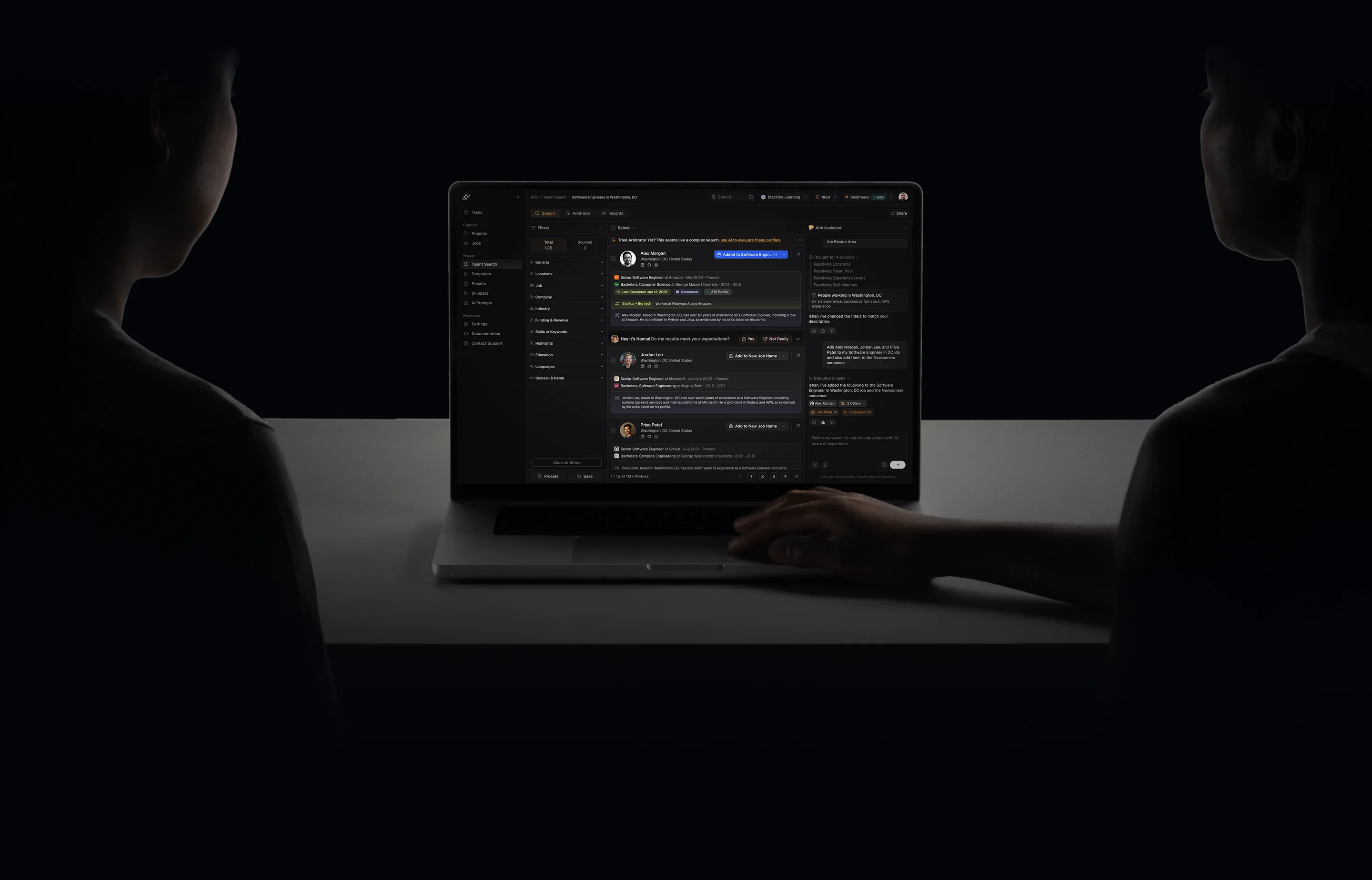


Recruiting does not happen at your desk anymore. It happens in between interviews, on the train, waiting for a hiring manager to join a call, or catching up on pipeline after hours. The best recruiters are always moving, and the best candidates do not wait around.
Most sourcing tools still assume you are sitting at a large monitor with a keyboard, a mouse, and an hour to spare. They were designed for desktop workflows, then squeezed onto a smaller screen. Buttons overlap, filters are hidden behind menus, and a simple task like reviewing a profile or sending a message takes five taps too many. When sourcing is forced into that experience, it simply does not get done on mobile.
Arbi was built with the opposite assumption. If you can run your entire sourcing workflow from your phone without compromise, you can run it anywhere. That is not a nice to have. It is how modern recruiting actually works.
The desktop assumption slows you down
When a tool is designed for desktop first, mobile becomes an afterthought. You get a responsive wrapper around a complex interface, not a native mobile experience. The result is familiar to anyone who has tried to source on their phone with a legacy platform.
You open a search and the filters are cramped or cut off. You try to view a candidate profile and you are pinching and scrolling to find the work history. You want to save a candidate to a project or send a quick outreach, but the action is buried. By the third time you have to switch back to your laptop to finish the task, you stop trying on mobile altogether.
That friction has a real cost. Sourcing is a habit, not an event. The teams that win are the ones that can act quickly when a great candidate appears, follow up the same day, and keep pipeline moving without waiting to be back at a desk. If your tool only works well on desktop, you are adding hours of delay to every search.
What mobile-first actually means in Arbi
Mobile-first does not mean a smaller version of the same page. It means rethinking the workflow for touch, speed, and context.
In Arbi, search, review, and engagement were designed to work with one hand. Filters are built for quick selection, not endless dropdowns. Profiles are laid out to surface what matters first: current role, experience, location, and fit, without scrolling through clutter. Saving to a project, adding a note, or sending a personalized message takes a tap, not a workflow.
This matters because sourcing on mobile is often interrupt-driven. You have two minutes between calls. You want to run a search, scan the top results, and take action before your next meeting starts. Arbi keeps that loop tight. You can start a search with natural language, refine it as you go, and engage candidates without ever needing to switch devices or re-learn the interface.
If a recruiter cannot complete a sourcing workflow on their phone, the product was not designed for how recruiters actually work.
Performance matters too. Arbi loads fast on cellular connections and keeps interactions smooth, so you are not waiting for heavy pages to render or watching spinners while a candidate list loads. It feels like a modern consumer app because that is the standard your team already expects from every other tool on their phone.
How Arbi compares when you are not at your desk
Many sourcing platforms, including well known options like Juicebox and Pin, were architected for desktop power users. They can be powerful at a desk, but the experience breaks down on mobile. Navigation that relies on hover states, dense tables, and multi-panel layouts does not translate to a phone. You end up with a view-only version of the product, not a working one.
Arbi was optimized for mobile from the start, so there is no degraded mode. The same capabilities you use on desktop are fully usable on your phone.
| Workflow | Arbi on mobile | Typical desktop-first tools |
|---|---|---|
| Start a new search | Natural language search bar, ready for quick input | Search builder designed for large screens and precise clicks |
| Refine and filter | Touch-optimized filters and chips | Dense filter drawers that require scrolling and precise selection |
| Review candidates | Clean, stacked profile cards built for vertical scanning | Wide tables and side panels that require horizontal scrolling |
| Take action | Save, note, and message in one or two taps | Actions hidden in menus or requiring desktop-only extensions |
The difference is not just visual. It changes whether mobile sourcing actually happens. With Arbi, recruiters can clear a sourcing queue while commuting or keep a search moving between onsite interviews. With desktop-first tools, that work waits until they are back at a laptop.
Sourcing should fit your day, not the other way around
The best sourcing tool is the one your team will actually use consistently. If it only works well in one context, adoption drops and pipeline suffers. Recruiters default to what is easiest in the moment, and if mobile is painful, they will do less of it.
Arbi removes that tradeoff. Whether you are at your desk or on your phone, you get the same speed, the same AI understanding of who you are looking for, and the same ability to move candidates forward. No feature gaps, no watered-down mobile view, no need to remember to finish it later.
A better standard for sourcing tools
- Full workflow on mobile: Search, filter, review profiles, save to projects, and send outreach without switching to desktop.
- Designed for touch: Large tap targets, readable cards, and navigation that works with a thumb, not a mouse.
- Fast and reliable: Optimized to load quickly and stay responsive on the go, so momentum is never lost.
Recruiting has always been about speed and timing. The teams that can find and engage talent first win. That advantage should not depend on where you are sitting.
Arbi makes sure it does not.