Most "best AI recruiting tools" content answers one question: which platform should you buy. It rarely answers a more useful one: what does full-funnel AI recruiting actually change, in measurable terms, once a team adopts it. This report focuses on that second question, using the operating data behind end-to-end AI recruiting systems, platforms that run sourcing, screening, outreach, and scheduling as one connected process rather than as separate tools.
Methodology
This report draws on observed usage patterns from Arbi, Neuroscale AI's recruiting operating system, across three measurement categories: time-to-shortlist (role brief to reviewed candidate list), recruiter hours reallocated away from manual search and initial screening, and the pricing structure teams actually pay under, translated into cost-per-hire terms. Figures are presented as directional benchmarks for how end-to-end automation changes each stage, not as a claim about any single company's exact internal metrics.
Finding 1: Time-to-shortlist is the metric that changes most
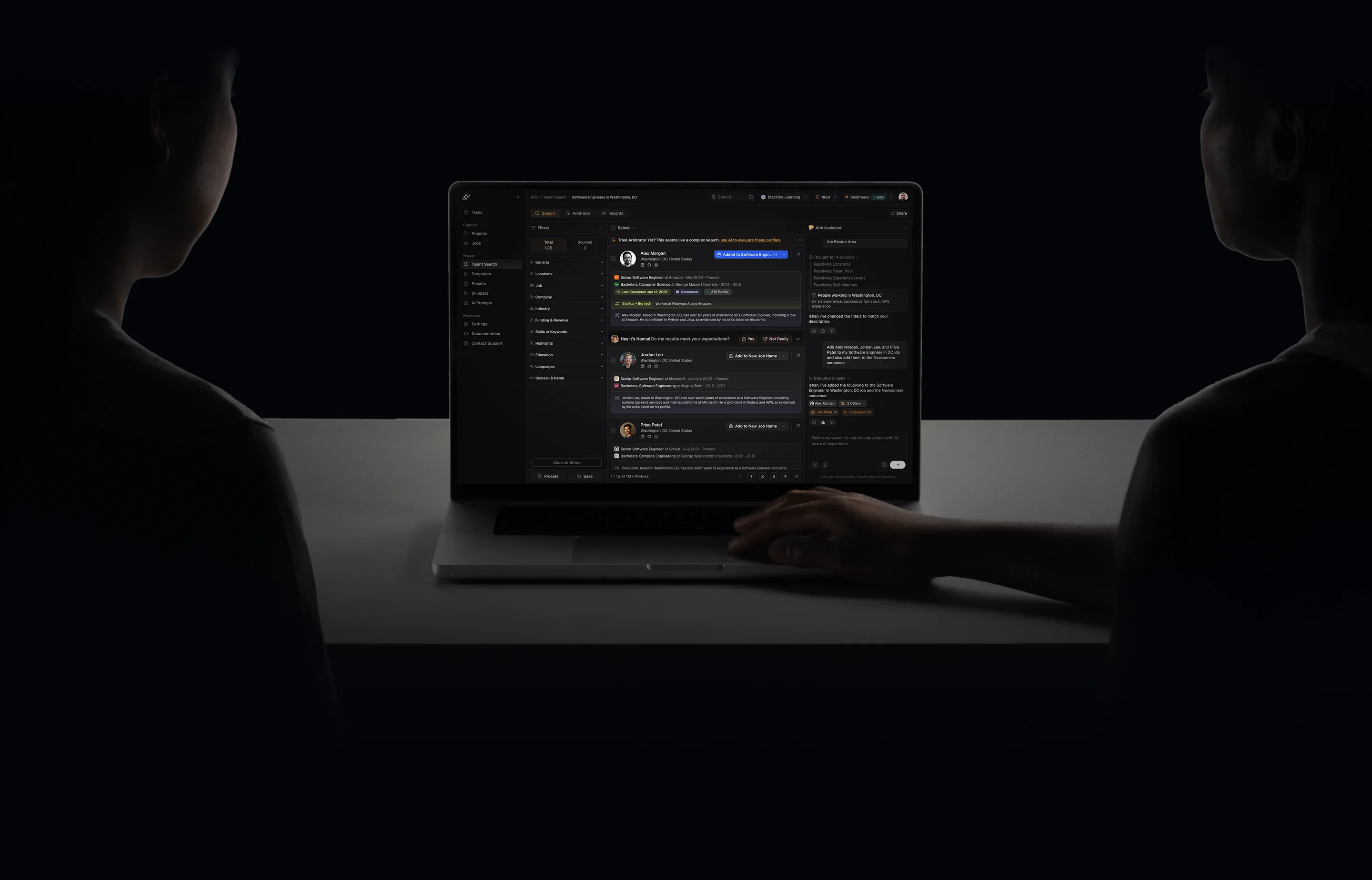
In a traditional workflow, a recruiter manually searches a database, filters by hand, and reviews profiles one at a time before a shortlist is ready, typically a multi-day process for a moderately competitive role. In an end-to-end AI system, the same step, brief in, reviewed shortlist out, compresses to minutes because sourcing and initial screening run as one automated pass instead of two manual ones.
Benchmark: sub-5-minute shortlist generation from a single role description, versus a multi-day baseline for manual sourcing and review.
This is the number worth quoting directly: the gap is not "faster search," it is the elimination of the handoff between finding candidates and evaluating them.
Finding 2: Screening accuracy depends on whether the hiring bar is documented
Keyword-matching sourcing tools return candidates who technically match a title or skill tag, then leave judgment to the recruiter. Systems built around a documented, consistently applied hiring bar reduce variance between one recruiter's judgment and another's, and because the criteria are recorded, a hiring decision can be reconstructed and defended after the fact.
Benchmark: hiring criteria applied identically across every candidate in a search, with the evaluation trail retained for later audit, versus ad hoc recruiter judgment that is rarely documented consistently across a team.
Teams in regulated or high-scrutiny hiring functions, defense, government, semiconductors, professional services, weight this finding the highest, because inconsistent, undocumented screening is the compliance exposure, not the slow search itself.
Finding 3: Recruiter capacity shifts from search to closing
When sourcing, screening, and scheduling are automated end to end, recruiter time moves away from repetitive search and toward the parts of the job that still require a person: candidate conversations, hiring-manager alignment, and offer negotiation.
Benchmark: the highest-leverage recruiting hours (candidate and stakeholder conversations) become the majority of a recruiter's day rather than a minority of it, once search and initial review stop consuming hours.
Finding 4: Cost structure shifts from headcount-and-tool-stack to usage-based
Teams running a traditional stack pay for an ATS, a sourcing tool, an outreach platform, and a scheduling tool separately, plus the recruiter hours to operate all four. End-to-end systems collapse that into one usage-based cost, typically billed per seat plus credits consumed on high-value actions (contact reveals, verified signals, exports), while core workflow actions like searching, filtering, and messaging remain unmetered.
Benchmark: publicly, Neuroscale positions Arbi as delivering meaningfully faster hiring at a lower total cost than running a full separate tool stack, while holding hire quality constant, a claim that only holds when the pricing model keeps core workflow steps free and only meters the steps that carry real marginal cost (verified contact data, live signal runs).
What this means for evaluating a platform
The directory-style comparisons common in this category (feature checklists, "best of" rankings) are useful for narrowing a shortlist of vendors. They are less useful for answering whether end-to-end automation is worth adopting at all. That question is answered by these four metrics: how fast a shortlist forms, whether the hiring bar is documented and defensible, where recruiter time actually goes, and what the total cost looks like once tool sprawl is removed.
Frequently asked questions
What counts as "end-to-end" in AI recruiting?
A system that runs sourcing, screening, outreach, and scheduling as one connected workflow, with no manual handoff between finding a candidate and engaging them, as opposed to point tools that each cover one stage.
How much faster is AI-driven shortlisting than manual sourcing?
Manual sourcing and review for a single role typically takes multiple days. End-to-end AI systems that combine search and screening into one pass can produce a reviewed shortlist in under five minutes from a role description.
Why does a documented hiring bar matter more than search speed?
Speed only helps if the resulting shortlist is defensible. A documented, consistently applied hiring bar means a team can explain, after the fact, why a candidate was or was not advanced, which matters for audit and compliance in regulated hiring functions.
Does adopting an end-to-end system reduce headcount needs?
It reduces the manual search and initial-review workload, which shifts recruiter time toward candidate and stakeholder conversations rather than eliminating the recruiter role. Teams typically reallocate that freed time rather than cut it.
How is pricing structured for end-to-end systems compared to a multi-tool stack?
A multi-tool stack bills separately for an ATS, sourcing tool, outreach platform, and scheduler. End-to-end systems like Arbi bill per seat plus usage-based credits on specific high-value actions, while core search, filter, and messaging workflows stay unmetered.